Top 7 most mysterious eternal flames in the world.

Fire is a great invention of humankind. Therefore, to honor it, fire is associated with myths, fairy tales, gods, and power. In Greek mythology, fire is represented by the god Hephaestus. Fire deserves to be clearly understood. You light a match, and it goes out; you burn a tree, and it withers away... But there are also fires that burn endlessly, enduring with the heavens and the earth. There are such fires, magical and mysterious.

1. Fire at the "Gates of Hell"

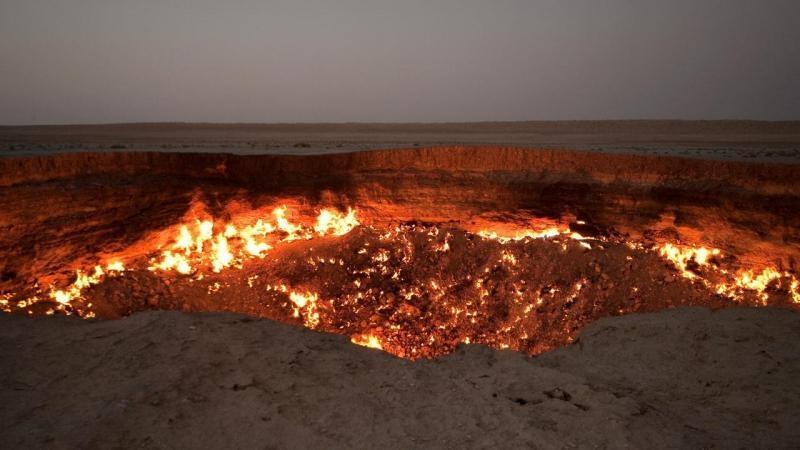
"The Gate of Hell" (or "Entrance to Hell") is the name the people of Derweze village give to this fire.

The Gate of Hell is located in the middle of the Karakum Desert, in Derweze village, Ahal province, Turkmenistan – a country with a prominent history related to Alexander the Great.

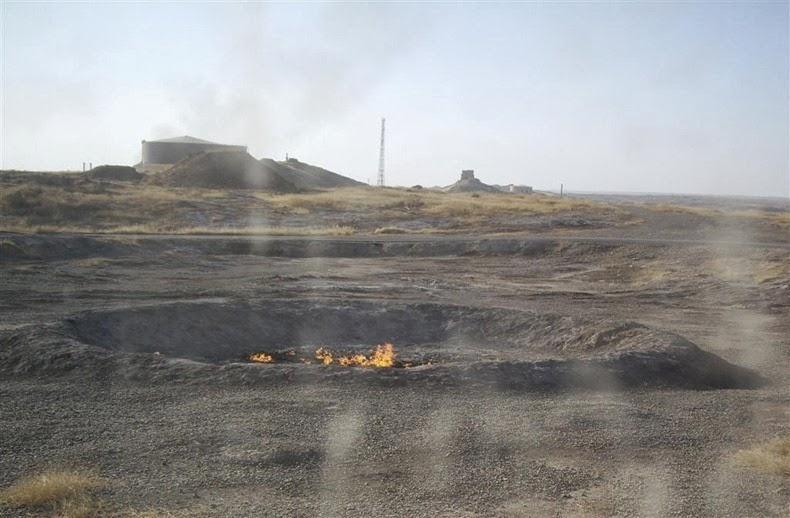
Actually, the Gate of Hell is a natural gas field. It is one of the largest natural gas fields in the world. It was discovered in 1971 by Soviet scientists. Soviet geologists placed drilling rigs there, believing it to be an oil field. Unfortunately, the ground beneath the rigs collapsed, creating a large crater 70 meters in diameter. Although there were no casualties, a large amount of methane gas escaped, posing a risk to the environment and people in the surrounding area. To avoid damage from toxic gas leaks, geologists chose to burn the gas completely, expecting it to burn out within a few weeks. But as you can see, the fire continues to burn to this day.

Perhaps the Gates of Hell are fascinating to us. But if the fire goes out, the Earth will suffer a massive amount of methane gas! So, let's hope it continues to burn brightly!
View Details

2. Flames behind a waterfall in Pennsylvania

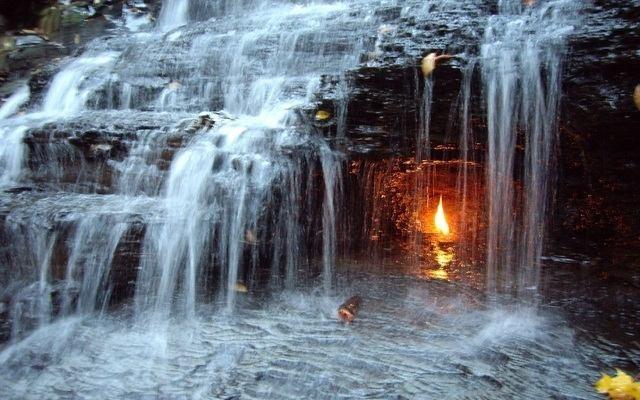
From a distance, one can easily discern the golden-orange light emanating from behind the curtain of water. There, a flame
burns. The flame is located in a small cave hidden behind a waterfall that continuously cascades down day and night. While water pours outside day and night, the flame burns brightly and mysteriously.

It is located in the ShaleCreek Preserve, south of Chestnut Ridge Park in Pennsylvania, USA. Scientists discovered that the small cave behind the waterfall can naturally emit ethane and propane gases, which are flammable. This flame
can burn year-round, but sometimes it is extinguished and needs to be relit.

This is one of the most mysterious natural flames in the world. While other perpetual flames burn due to factors such as environment, temperature, and special gases surrounding them, scientists have proven that the temperature
inside this small cave is not sufficient to sustain such a flame. Strange, isn't it?

Is there some mysterious force at play here? That's an answer you'll have to discover for yourself!
View Details

3. Flames behind a waterfall in Pennsylvania

From a distance, one can easily discern the golden-orange light emanating from behind the curtain of water. There, a flame
burns. The flame is located in a small cave hidden behind a waterfall that continuously cascades down day and night. While water pours outside day and night, the flame burns brightly and mysteriously.

It is located in the ShaleCreek Preserve, south of Chestnut Ridge Park in Pennsylvania, USA. Scientists discovered that the small cave behind the waterfall can naturally emit ethane and propane gases, which are flammable. This flame
can burn year-round, but sometimes it is extinguished and needs to be relit.

This is one of the most mysterious natural flames in the world. While other perpetual flames burn due to factors such as environment, temperature, and special gases surrounding them, scientists have proven that the temperature
inside this small cave is not sufficient to sustain such a flame. Strange, isn't it?

Is there some mysterious force at play here? That's an answer you'll have to discover for yourself!
View Details

4. Yanar Dag Fire Temple

The Republic of Azerbaijan is probably no stranger to football fans worldwide. However, today we will explore another interesting aspect of this country: the never-ending burning mountain, Yanar Dag (The Burning Mountain).

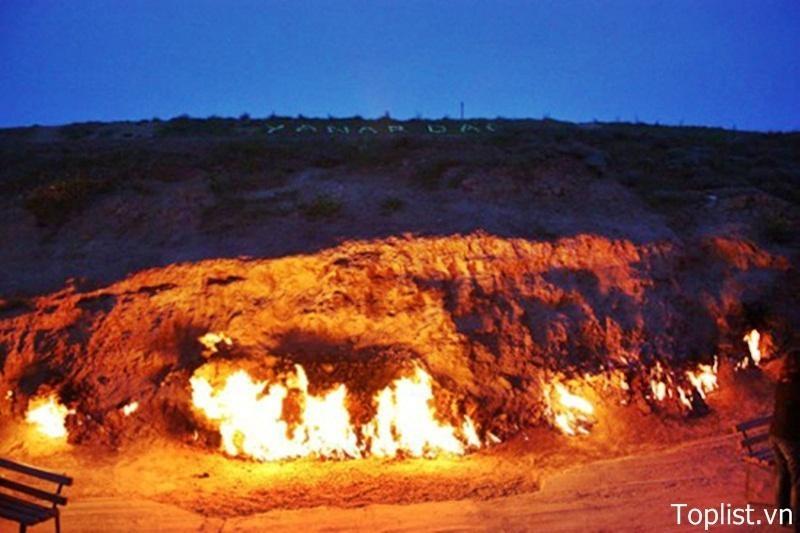
This is a 10-meter-long wall of fire, a continuously burning blaze on a hillside on the Absheron Peninsula, on the Caspian Sea near Baku, the capital of Azerbaijan – a place known as the "Land of Fire".

In reality, it is a natural gas deposit. The flames originate from vents in the sandstone, forming and rising to a height of 10 meters. Unlike mud volcanoes, the Yanar Dag fire burns quite steadily due to gas leaks from the ground. Because it burns continuously, the air here is almost entirely covered by a thick layer of gas. Therefore, geologists have studied and speculated that it is a large gas deposit.

The fire started in 1950 when a passing shepherd accidentally ignited it. The flames spread, causing nearby streams to catch fire as well; these streams are known as Yanar Bulaq. Local people use the water for bathing to treat illnesses. According to folklore, the mountain has a long-standing religious connection, and the people revere this fire.

This is an interesting mountain, a captivating tourist destination in Azerbaijan, attracting a large number of visitors each year to admire this fascinating fire.
View Details

5. The flame at Jwalamukhi Temple

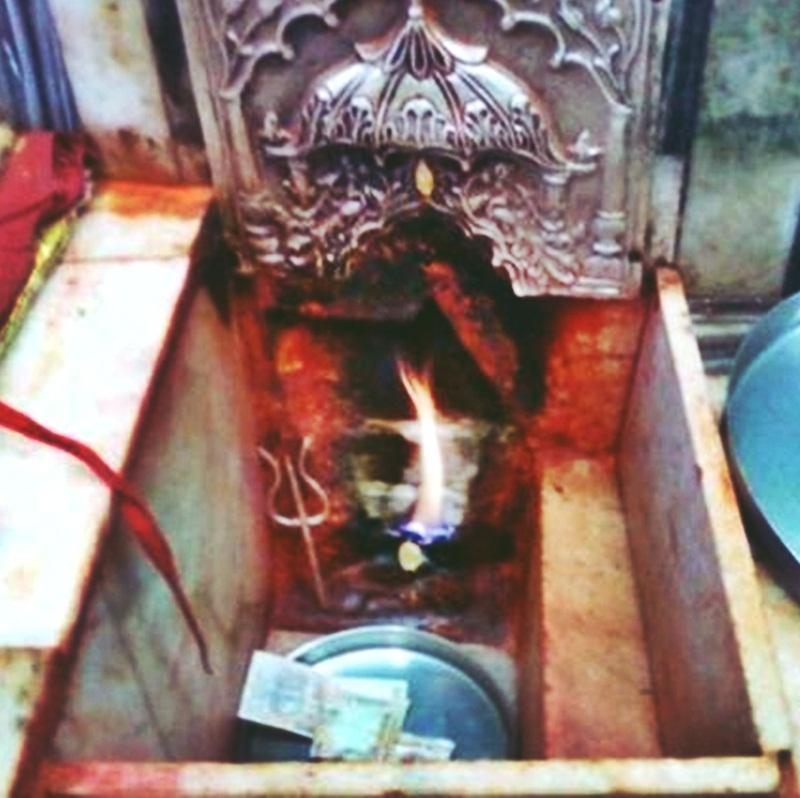
The flame burns forever at Jwalamukhi Temple in India. In Vietnam, have you ever heard of the red soil region of the Central Highlands? Beyond its simple geographical features, this land is steeped in legends about dragons: long ago, there was a ferocious dragon that committed many evil deeds, but the brave people of this region decided to fight it. After many battles, the dragon was defeated, its blood flowed like a river and seeped into the land, creating the red soil of the Central Highlands today. Well, perhaps this legend isn't directly related to the flame at Jwalamukhi Temple (blushing), but what I want to say is that everything in the world has its legend, and the flame at Jwalamukhi Temple is no exception.

In fact, the legend of the red land has similarities to the legend of the fire at Jwalamukhi Temple, which is the remains of a body, but more horrifyingly, at Jwalamukhi Temple it is a human body.

According to Hindu legend, Daksha was one of the children of Lord Brahma residing in the Northwest. It is said that Sati (Daksha's youngest daughter, who had many children) and Lord Shiva (her husband) were not accepted by Daksha; he greatly disliked Shiva. During a feast, King Prajapati Daksha humiliated Sati, causing her to jump into the sacrificial fire and burn herself. In revenge, Shiva beheaded Daksha and wreaked havoc on the land, wandering everywhere with his wife's incomplete body.

Finally, Lord Vishnu cut Sati's body into many pieces and scattered them throughout the places Shiva visited. A piece of Sati's tongue fell into the Jwalamukhi temple, which was later dedicated to the Goddess of Light. It is considered sacred, especially the flame in the temple which continues to burn brightly.
View Details


6. Baba Gurgur Flame

Located near the city of Kirkuk in northern Iran, Baba Gurgur was known as the world's largest oil and gas field until 1948.
Discovered in 1927, this flame, situated in the center of the oil field, continues to burn as natural gas seeps through the hard rock.

Legend has it that pregnant women hoping to give birth to a son should visit this flame. The Baba Gurgur flame may be the origin of the story of the Furnace in the Bible: King Nebuchadnezzar threw three Jewish disciples into the furnace for refusing to bow before a golden statue of a god.

Locals have utilized the natural resin from Baba Gurgur for road construction and other purposes. Naturally, this flame attracts many tourists. However, the flame emits toxic fumes, so tourists can choose to view it from afar in the city or visit it directly, but must stand upwind to avoid inhaling the toxic smoke.
View Details

7. Mount Wingen Volcano

Mount Wingen is located near the town of Wingen, New South Wales, Australia. The volcano is formed by smoldering coal seams underground, possibly caused by lightning strikes or spontaneous combustion.

Locals claim the volcano has been burning continuously for 6,000 years. Paleontologists believe this may be the longest-burning coal seam in history.
Each year the fire spreads approximately 1 meter southward, and has already spread at least 6 kilometers since its formation. At this rate, within the next 255,000 years it will reach the outskirts of Sydney, a distance of 280 kilometers.
View Details
Like the Top 7 most mysterious eternal flames in the world.? share me

Would you like to write a review for your company or brand?

Contact Us

promotionsand ADs

category banner
category banner
category banner