2. Statues of people on Easter Island
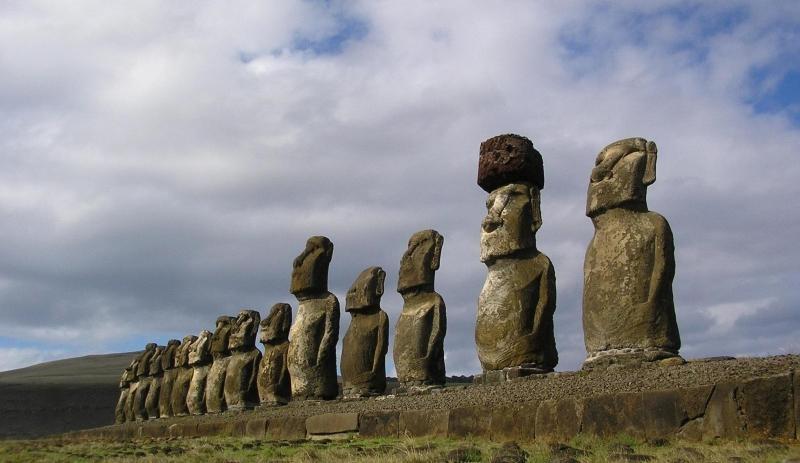
Easter Island is an island in the southeastern Pacific Ocean, under Chilean sovereignty, located at the southeasternmost point of the Polynesian Triangle. Easter Island is famous for its 887 stone statues, called moai, created by the ancient Rapa Nui people. In 1995, UNESCO recognized Easter Island as a World Heritage Site, with most of its area protected within the Rapa Nui National Park. The Polynesians may have arrived on Easter Island between 700 and 1100 AD, creating a rich and developed culture, as evidenced by the moai statues and other artifacts. However, human activity, the appearance of rats, and overpopulation led to deforestation and depletion of natural resources, resulting in the decline of the Rapa Nui civilization. When Europeans arrived in 1722, the island's population had dwindled to just 2,000-3,000, down from an estimated 15,000 a century earlier. Disease and the slave trade further reduced the Rapa Nui population, to only 111 in 1877. Easter Island is one of the most remote inhabited islands in the world. The nearest inhabited island is Pitcairn, 2,075 km away; the nearest town is Rikitea, with a population of just over 500, located on Mangareva Island, 2,606 km away; and the nearest mainland point is in central Chile, 3,512 km away.
Easter Island is a special territory of Chile, annexed in 1888. Administratively, it belongs to the Valparaíso region and, more precisely, it is the only commune in the Isla de Pascua province. According to 2012 statistics, the island has 5,800 inhabitants, of which about 60% are indigenous Rapa Nui people. Easter Island was discovered by the Dutch explorer Jacob Roggeveen on Easter Sunday in 1722, hence its name. The island, located in the Southeast Pacific, is now owned by Chile. What makes Easter Island mysterious are the giant stone statues called Moai, estimated to be about 6,000 years old. Scattered across the island, these statues are believed to belong to the Rapa Nui civilization that lived there. Currently, scientists have excavated and discovered that the lower bodies of the statues on Easter Island are still buried. Hopefully, in the future, the mystery of the statues on Easter Island – one of humanity's greatest mysteries – will be solved.
The colossal stone statues on Easter Island have always been a major mystery for humanity.
View Details